2026 Helderberg Crime Trends: Defeating Opportunistic Theft and Securing Your Gate Motor
If you live in Gordon’s Bay, Somerset West or Strand, you’ve likely heard the same story more than once this year:
A gate won’t open in the morning.
The motor housing is gone.
Cables are cut clean.
This is not organised home invasion. It’s opportunistic property crime — fast, targeted, and designed to be low risk.
In 2026, one of the most common weak points in suburban perimeter security across the Helderberg is the exposed gate motor.
This article breaks down:
- Why gate motor theft is increasing
- How criminals remove them
- What engineering upgrades actually work
- How to secure your perimeter properly
No fear tactics. Just practical defence.
Understanding Opportunistic Theft in Helderberg (2026)
Opportunistic theft is not sophisticated burglary. It relies on:
- Speed
- Minimal noise
- Poorly secured equipment
- No alarm integration
Across the Helderberg, we are seeing:
- Gate motors lifted from mounting plates
- Power cables cut and removed
- Control boards stolen
- Motors stripped for resale parts
Areas with easy street access and visible motor housings are most vulnerable.
This is not random. Criminals look for:
- Standard mounting brackets
- Plastic motor housings
- Exposed conduit
- No visible tamper wiring
If your motor can be removed in under 3 minutes, it will be.
Why Gate Motors Are Vulnerable
Most residential gate motors were installed for convenience — not security.
Common weaknesses include:
Standard Mounting Plates
Thin base plates bolted into brickwork without reinforcement can be sheared off using leverage.
Plastic Housings
Most motors use polymer casings. These can be cracked or removed quickly to access internal wiring.
Exposed Cabling
Power and control cables often run externally in basic conduit. A single cut isolates the system.
No Alarm Integration
In many homes, the gate motor operates independently of the main alarm.
Result:
The motor is removed and the house alarm never triggers.
How Criminals Remove Gate Motors (Technical Breakdown)
Understanding the method helps engineer the defence.
1. Power Isolation
The attacker cuts visible live feed cables first. This disables response systems.
2. Bolt Cutting or Shearing
Standard anchor bolts are either:
- Cut
- Levered loose
- Snapped at weak bracket points
3. Bracket Failure
Lightweight brackets bend under force. Once loosened, the motor lifts free.
4. Rapid Exit
The entire process can take 2–4 minutes if no alarm is triggered.
If your motor is not mechanically reinforced and electrically monitored, it is vulnerable.
Engineering Solutions That Actually Work
This is where perimeter security shifts from installation to engineering.
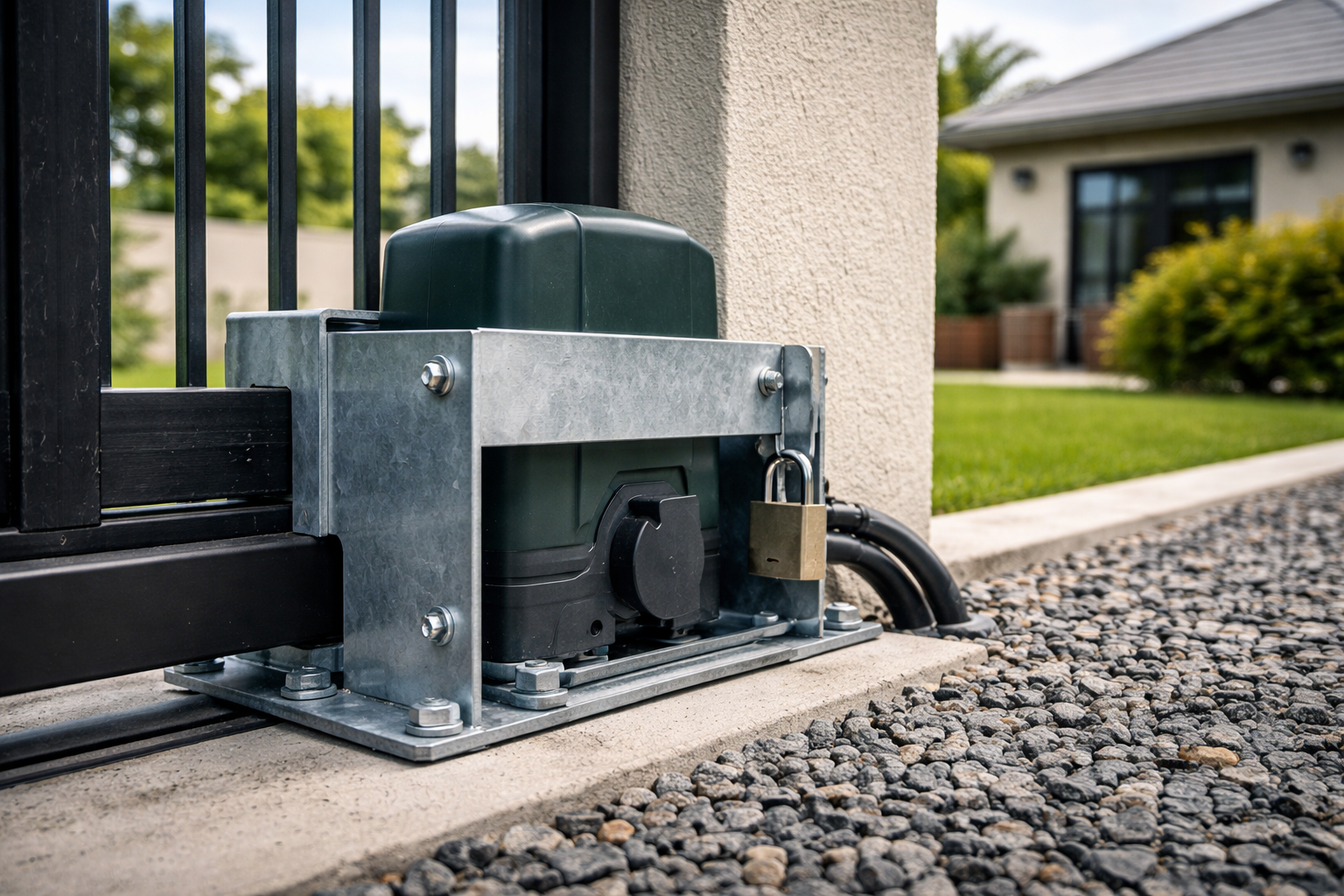
1. Solid Steel Anti-Theft Brackets
Proper anti-theft brackets:
- Are fabricated from thick-gauge steel
- Enclose the motor base
- Prevent leverage access
- Shield anchor bolts
Light decorative brackets are not sufficient.
2. Reinforced Mounting Plates
A reinforced base plate should:
- Be anchored deep into structural masonry
- Use tamper-resistant fasteners
- Distribute force across a wider surface area
3. Steel Motor Cages
In higher-risk zones, full steel cages provide:
- Physical enclosure
- Bolt shielding
- Tamper deterrence
They must be properly ventilated and corrosion-protected for coastal environments.
4. Concealed Cabling
All power and control wiring should:
- Run internally where possible
- Use armoured conduit
- Avoid visible external routing
If cables are visible, they can be cut.
Linking the Gate Motor to the Main House Alarm
This is the most overlooked upgrade.
A standalone motor is a soft target.
Proper integration includes:
- Tamper output connected to alarm zone
- Immediate trigger on housing removal
- Trigger on power interruption
- Audible and remote notification
If the motor is touched or opened, the house alarm should activate instantly.
Delay equals opportunity.
Alarm Integration Strategy (Technical Overview)
Tamper Circuit Monitoring
Most gate motors include tamper terminals. These must be:
- Wired into a 24-hour monitored zone
- Configured for instant trigger
- Tested quarterly
Immediate Notification
When linked correctly:
- The siren activates
- Armed response is notified
- Mobile app alerts homeowner
This removes the “silent removal” advantage.
Preventative Checklist for Homeowners
You can assess your own vulnerability in minutes.
Check the following:
- Is your motor protected by a steel anti-theft bracket?
- Are mounting bolts exposed?
- Are cables visible outside the wall?
- Does your alarm trigger if the motor housing is opened?
- Has the installation been reviewed in the last 12 months?
If more than one answer is “no”, your motor is likely vulnerable.
Local Scenario: Strand Residential Property
A Strand property experienced repeated cable cutting over several months.
Assessment revealed:
- Standard mounting plate
- No tamper wiring
- Exposed conduit
- No bracket reinforcement
Upgrades implemented:
- Custom steel anti-theft bracket
- Reinforced base anchoring
- Concealed cabling reroute
- Tamper linked to perimeter alarm zone
Result:
Subsequent tamper attempt triggered full alarm activation. No further theft incidents reported.
The system didn’t become invisible. It became resistant.
Why This Matters for Helderberg Crime Trends 2026
Opportunistic theft thrives on predictable weakness.
Gate motors are:
- External
- Visible
- Electrically accessible
- Often unmonitored
A properly engineered perimeter removes those advantages.
Security is not about reacting to crime.
It is about removing opportunity.
FAQ
How common is gate motor theft in Helderberg?
It remains one of the more frequent forms of opportunistic perimeter theft because motors are external and easily accessible if not reinforced.
Do anti-theft brackets really work?
Yes — when fabricated from solid steel and properly installed. Lightweight decorative covers do not provide meaningful resistance.
Can criminals still remove protected motors?
With enough time and tools, almost anything can be removed. The goal is to increase resistance and trigger immediate alarm response, making the attempt high-risk.
Should gate motors be insured separately?
Most homeowners policies include gate motors, but verify coverage limits and theft clauses with your insurer.
Final Word
The 2026 Helderberg crime pattern is not sophisticated invasion — it is speed-based opportunism.
If your gate motor:
- Is not bracketed,
- Is not reinforced,
- Is not linked to your main alarm,
Then it is exposed.
Perimeter security in Gordon’s Bay, Somerset West and Strand must be engineered — not assumed.
Book a Gate Motor Security Assessment
We assess:
- Bracket strength
- Mounting integrity
- Cable exposure
- Alarm integration
- Coastal corrosion impact
If you want your perimeter to resist opportunistic theft — not invite it — we will evaluate and upgrade it correctly.
Gate motor security is not cosmetic.
It is structural.