The Coastal Challenge: Why Salt Air is the Silent Killer of Helderberg Security Systems
For residents of the Helderberg basin, the ocean is our greatest neighbor. Whether you’re enjoying a sunset stroll on Strand’s Beach Road or looking out over the panoramic vistas of False Bay from the heights of Spanish Farm, the sea defines our lifestyle. But for your home security system, that same ocean breeze is a relentless adversary.
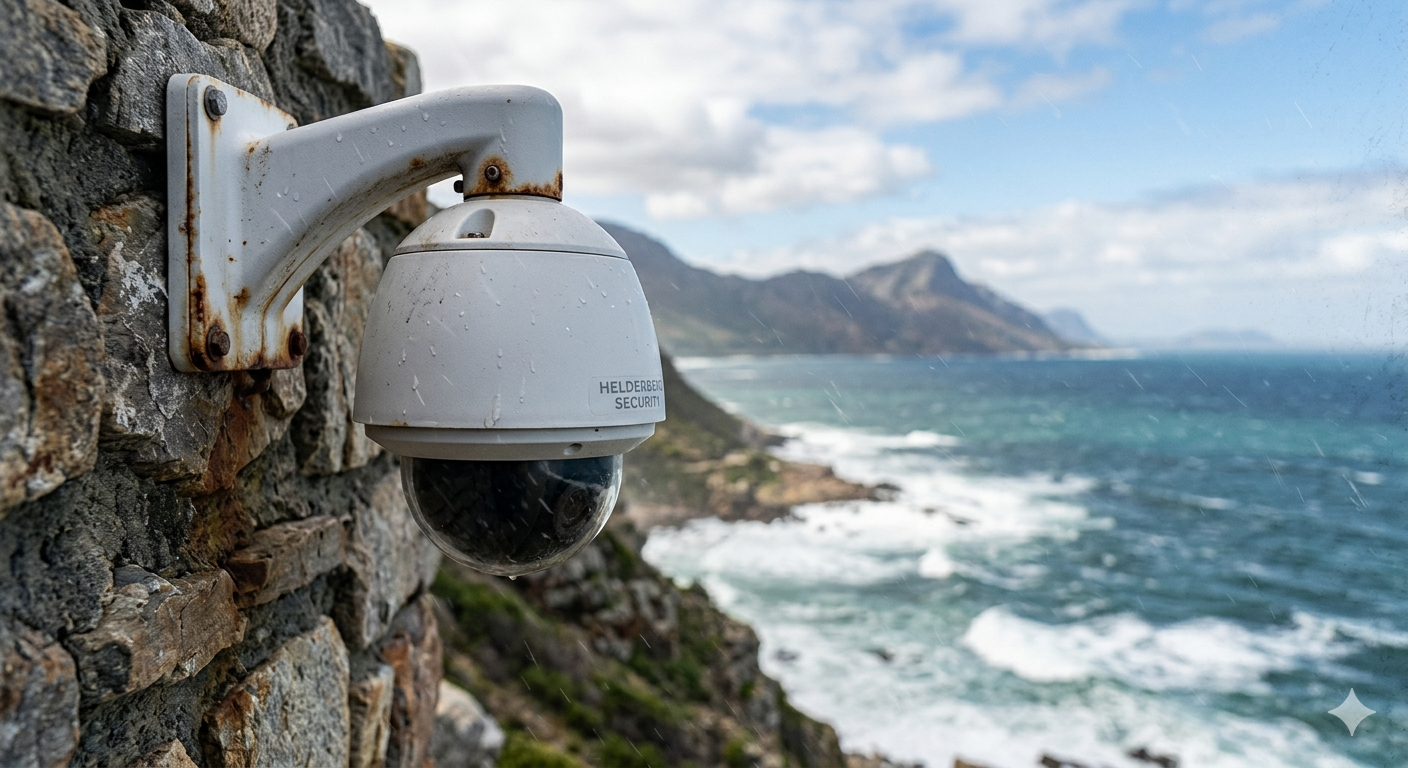
At Helderberg Security, we’ve spent years maintaining systems across Somerset West, Strand, and Gordon’s Bay. We’ve seen firsthand how the “Coastal Challenge” can turn a premium security investment into a pile of rusted metal and failing circuits in a matter of months.
If you want to ensure your family remains protected, you need to understand why salt air is the silent killer of security hardware—and how to fight back.
1. The Science of Corrosion: What’s Really Happening?
To the naked eye, salt air is just a mist. To your security cameras and outdoor beams, it is a high-speed chemical assault.
The primary culprit is Galvanic Corrosion. Most “entry-level” security cameras use cheap aluminum alloy brackets and zinc-plated screws. When salt-laden moisture (an electrolyte) settles on these dissimilar metals, it creates a tiny electrical circuit. This process accelerates oxidation, eating through protective coatings and seizing moving parts.
In the Helderberg, this isn’t a theoretical problem. A camera installed on a beachfront apartment in Strand faces a corrosion rate up to ten times higher than a camera installed just five kilometers inland in the Somerset West CBD. Without the right hardware, your “eyes on the street” will be blinded by rust before the year is out.
2. The Local Micro-Climate: Strand vs. Somerset West
Experience has taught us that the Helderberg isn’t a “one-size-fits-all” environment. Your geographic location dictates your hardware requirements:
- The “Splash Zone” (Beach Road & Gordon’s Bay Harbor): Here, the salt spray is direct. Standard IP66 ratings (which protect against dust and water) are insufficient. We’ve seen plastic housings become brittle and crack due to high UV exposure combined with salt crystallization.
- The “Corrosive Mist” (Spanish Farm & Fairhaven): While these areas are higher up, the famous South-Easter wind carries fine salt particles directly into the mountainside. Because it feels “dryer” here, many homeowners neglect maintenance, only to find their outdoor PIR (Passive Infrared) sensors have failed because salt air bypassed a cheap rubber seal.
3. The Professional Solution: Hardware Built for the Coast
When we design a system for a Helderberg home, we don’t shop at general retail stores. We specify marine-grade or high-durability equipment designed to withstand the Western Cape’s extremes.
The Power of IP67 and Beyond
While most installers settle for IP66, we prioritize IP67-rated housings. This ensures the unit can withstand temporary immersion and, more importantly, provides a much tighter seal against the microscopic salt fogs common in False Bay.
Material Matters
We recommend brands like AJAX for wireless peripherals because of their superior high-grade plastic polymers that don’t degrade under SA’s harsh UV rays. For wired CCTV, we often utilize Hikvision’s Anti-Corrosion series, which features powder-coated finishes and 316L stainless steel components—the same grade used on high-end yachts.
Smart Placement
Expertise isn’t just about the “what”; it’s about the “where.” We utilize the natural architecture of your home—eaves, overhangs, and recessed entry points—to shield sensitive sensors from the direct line of the South-Easter, extending the life of your gear by years.
4. Maintenance Advice: The Helderberg Pro-Tip
Even the best hardware needs a little love when it lives by the sea. If you want to maximize your system’s lifespan, follow this “Coastal Care” routine:
The Spanjaard Secret: > Twice a year, use a specialized electrical contact cleaner (like Spanjaard Electric Motor Cleaner) on external ports and cable junctions. This displaces moisture and leaves a thin protective film that salt can’t easily penetrate.
Avoid the “Salt Blur”: > Never wipe a dry camera lens. Salt crystals are abrasive. Use a gentle puff of air or a very wet microfiber cloth to wash away salt before drying. This prevents micro-scratches that ruin your night vision clarity.
5. The Trust Factor: Why Local Expertise Wins
There are plenty of “fly-by-night” installers who drive in from inland provinces or northern suburbs to do a quick job in Somerset West. They use the same hardware they’d use in a dry, landlocked environment. By the time your camera bracket snaps or your outdoor beam starts false-triggering due to a corroded circuit board, they’re long gone.
Helderberg Security is part of this community. We know which street corners get the worst of the spray and which hillsides face the most punishing winds. Our PSIRA-certified team doesn’t just “plug and play”; we engineer solutions that respect the environment we live in.
Is Your System Sea-Ready?
Don’t wait for a “System Failure” notification in the middle of a stormy night. If your security hardware is showing signs of white powdery residue, rust streaks, or foggy video, it’s already under attack.
Contact Helderberg Security today for a comprehensive Coastal Security Health Check. We’ll audit your current hardware and ensure your home remains a fortress—no matter what the ocean throws at it.