In the rapid evolution of Helderberg’s security landscape, 2026 has become a crossroads. We’ve seen an explosion of “smart” DIY kits and high-resolution cameras flooding the market from Somerset West to Gordon’s Bay. But there is a growing frustration among homeowners: the boy who cried wolf syndrome.
When your phone buzzes at 2:00 AM because a gust of our notorious South-Easter moved a branch or a neighborhood cat strolled across the driveway, the “smart” technology starts to feel a lot like noise. This is where the intersection of technical search signals and human authority—what we call the Coetzee Convergence—becomes critical. True security isn’t just about capturing pixels; it’s about the intelligent filtration of data followed by decisive human action.
The Technical Mechanics: Beyond Motion Detection
Traditional motion detection is binary—it sees change and triggers an alert. In a high-salt, high-wind environment like the Helderberg Basin, this is fundamentally flawed.
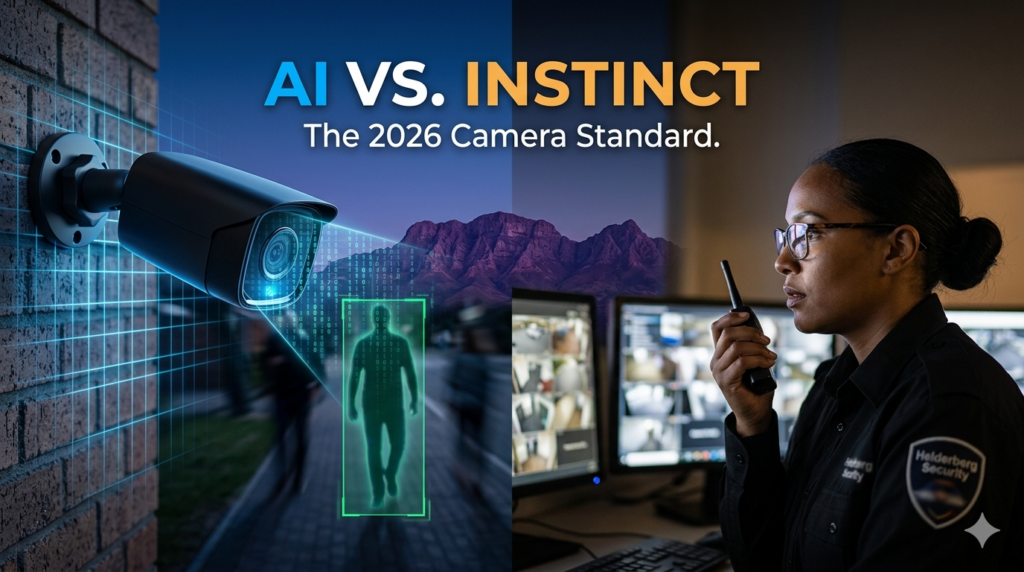
Modern AI-powered video analytics utilize deep learning models to perform object classification. Instead of just seeing “movement,” the system uses edge computing to identify “human-shaped” anomalies. It calculates gait, posture, and persistence.
- Pixel-Level Analysis: The AI distinguishes between the erratic movement of vegetation and the purposeful, linear movement of a human.
- Filtering Environmental Noise: Our systems are calibrated to ignore the “visual grit” of the Western Cape—from salt spray on the lens in Gordon’s Bay to the shifting shadows during a sunset over the Hottentots Holland Mountains.
By the time an alert reaches our control room, the AI has already performed a thousand micro-calculations to ensure that what we are looking at is a legitimate security event.
Why the “Human Back-End” is Irreplaceable
If AI is the engine, human instinct is the steering wheel. We often see tech companies marketing “automated response,” but in the complex socio-economic fabric of South Africa, automation has limits.
- Contextual Intelligence: An AI might see a person at your gate at 11:00 PM. It knows it’s a human. However, a trained operator in our Somerset West control room knows the difference between a neighbor looking for a lost dog and a “scout” marking a property.
- Mitigating App Fatigue: The greatest risk to a homeowner is “muting” their security. When you receive 20 false alerts a day, you eventually stop checking. Our human back-end acts as the ultimate filter. You only get the call when the threat is verified.
- The Tactical Force Multiplier: When a breach is confirmed, the AI feeds our response teams real-time metadata. They aren’t going in blind; they know exactly where the intruder is, what they are wearing, and if they are armed, all before they even turn onto your street.
The Sovereign Stack: Protecting Your Data and Your Home
As a technical strategist, I advocate for the Sovereign Stack approach. Many off-the-shelf smart cameras pump your private footage into generic, offshore cloud servers. This creates a dual risk: latency in response and a massive privacy vulnerability.
At Helderberg Security, we prioritize infrastructure where data is self-owned. By keeping the analytical processing local or within a secured, private South African framework, we ensure that your 2026 smart home standards include end-to-end encryption and data sovereignty. Your security footage should be a tool for your protection, not a data point for a third-party corporation.
2026 Standards: A Technical Spec Checklist
When auditing your current system, look for these non-negotiables:
| Feature | Why It Matters |
|---|---|
| Edge Analytics | Processes data on the camera to reduce latency and false alarms. |
| Object Classification | Specifically distinguishes humans and vehicles from animals and trees. |
| Low-Light Color Tech | Essential for identifying clothing colors and vehicle makes in the dark. |
| Sovereign Storage | Ensures your data stays within South African jurisdiction. |
Conclusion: The Future is Hybrid
The “human vs. machine” debate is a false dichotomy. In the Helderberg, the most robust security systems are those that use AI to do the heavy lifting of data filtration, leaving the high-stakes decision-making to the people who know these streets best.
Don’t let your security become another ignored notification on your phone. It’s time to move toward a system that values technical precision as much as it values human intuition.
Is your current system crying wolf? Contact us today for a technical audit of your home’s “blind spots” and let’s build a security stack that actually watches over you.