Power Cuts and Cable Theft: Keeping Your Alarm Active in the Helderberg Basin
In the Helderberg Basin, security engineering must account for more than perimeter design and wind calibration. Power instability and cable theft create a second layer of vulnerability that many systems are not configured to handle properly.
Load shedding, unplanned outages and infrastructure theft create predictable windows where poorly configured systems fail. In some cases, power is deliberately cut to reduce detection before intrusion attempts.
The solution is not panic or overspending. It is structured resilience: correct alarm battery backup, appropriate inverter support, and communication redundancy that keeps your system active when the grid drops.
What Happens to Your Security System During a Power Cut
When municipal power fails, most residential systems switch to internal battery standby. What happens next depends entirely on how the system was designed.
Alarm Panel
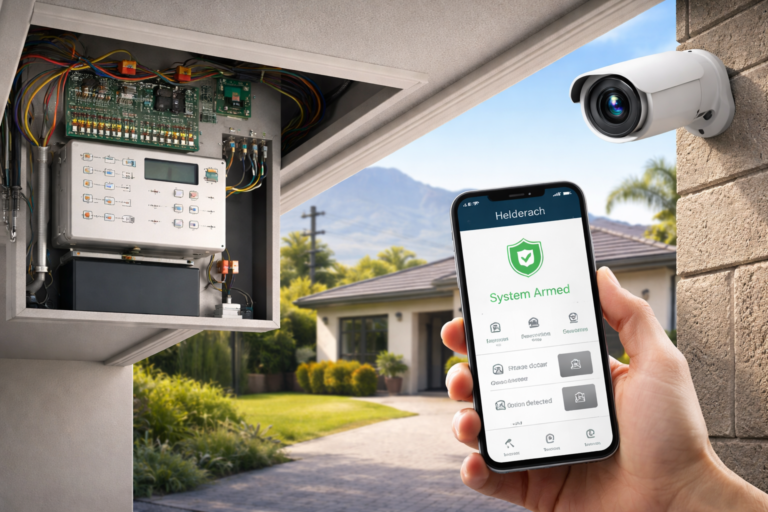
The alarm panel immediately draws from its backup battery. Modern panels with communicators, expanders and keypads consume more standby current than older analogue systems.
Outdoor Beams and Expanders
Perimeter beams and wired expanders continue operating if battery capacity is sufficient. If voltage drops below operational threshold, false triggers or shutdown may occur.
Electric Fence Energiser
Most energisers include small backup batteries, but runtime varies widely. Extended outages can reduce output voltage, weakening deterrence.
Gate Motor
Gate motors typically operate on separate battery systems. If not maintained, access failure becomes a practical issue during outages.
CCTV and NVR
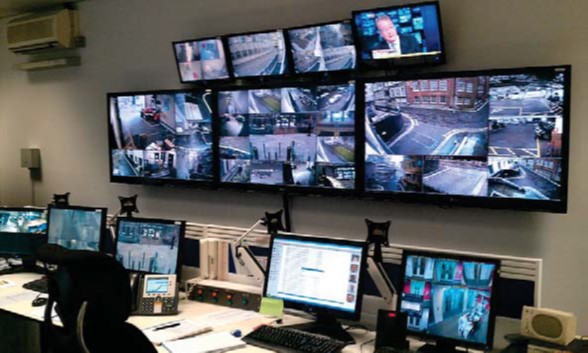
Unless connected to inverter backup, CCTV systems usually shut down immediately. Detection may continue via alarm, but visual verification is lost.
Router and Fibre ONT
This is the most overlooked failure point. If the router and fibre ONT lose power, IP communication fails even if the alarm panel remains active.
Security during outages depends on the full dependency chain:
- Power supply
- Alarm panel
- Communication module
- Router and fibre device
- Monitoring infrastructure
If one element fails, notification fails.
Why Standard Lead-Acid Batteries Are No Longer Sufficient
Traditional sealed lead-acid batteries were designed for shorter outages and lower current draw.
Modern systems face:
- Higher standby consumption from IP communicators
- Additional keypads and wireless expanders
- Continuous GSM/LTE radio draw
- Extended load shedding cycles
Common failure patterns include:
- Voltage sag under load
- Reduced usable capacity after two to three years
- Slow recharge between outage cycles
- Sulphation reducing effective runtime
A battery may test “acceptable” at rest but collapse under real load conditions during a prolonged outage.
Lithium Backup Batteries: A Smarter Upgrade
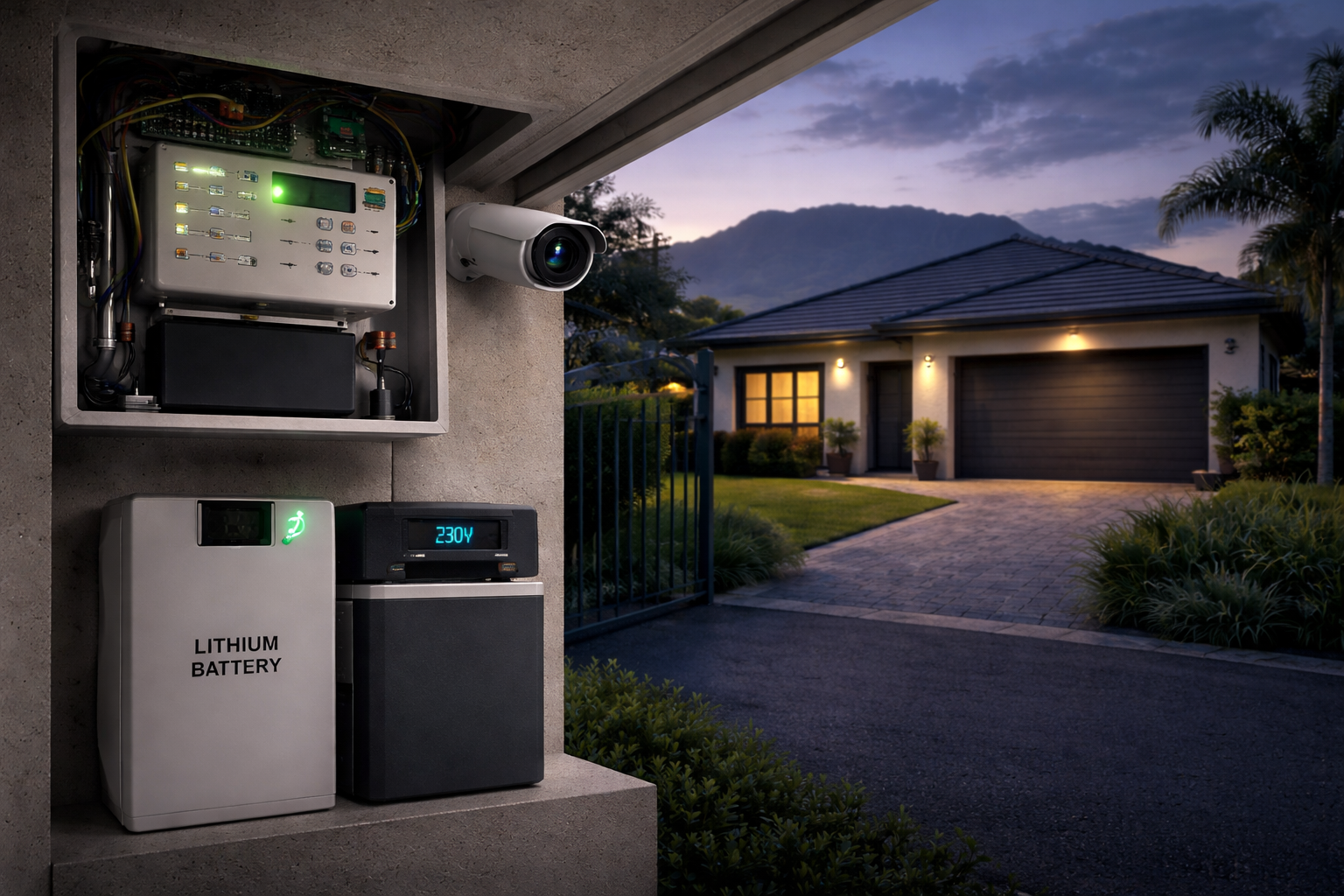
Lithium backup batteries for alarm systems offer measurable improvements in resilience.
Higher Usable Capacity
Lithium chemistry allows deeper discharge without rapid degradation, extending usable runtime.
Stable Voltage Output
Voltage remains more consistent during discharge, improving panel stability.
Faster Recharge
Recharge cycles are shorter, which matters when outages occur multiple times per day.
Longer Cycle Life
Where lead-acid batteries may require replacement every two to three years, lithium systems often provide extended service life under correct charging conditions.
Compatibility must be verified. Panel charger output, current limits and internal regulation must support lithium battery specifications. Upgrade decisions should be based on panel model and load calculation.
Inverters for Security Systems
Inverters for security systems provide broader resilience when designed correctly.
Instead of backing up the entire home, a dedicated “security essential circuit” is more efficient.
Security Essential Circuit Should Include:
- Alarm panel
- Router and fibre ONT
- CCTV and NVR
- Electric fence energiser
This targeted approach reduces load demand and extends runtime.
Oversizing systems unnecessarily increases cost and complexity. The objective is continuity of detection and communication — not powering non-essential household appliances.
Communication Resilience When Towers Go Down
Detection without communication is incomplete security.
During infrastructure instability, cell tower outages can occur due to:
- Extended power loss at tower sites
- Fuel shortages for generators
- Infrastructure vandalism
Dual-Path Communication
Modern systems use IP and LTE pathways simultaneously. If fibre fails, LTE remains active. If LTE fails but fibre is active, IP continues.
Router Backup
Without router battery backup, IP communication fails even if the alarm panel is active.
Antenna Placement
Proper GSM antenna placement improves signal stability during marginal network conditions.
Communication resilience is as critical as sensor reliability.
Practical Upgrade Checklist
- Check battery age and chemistry
- Measure panel current draw
- Define runtime target (2h, 4h, 8h)
- Confirm router and ONT backup
- Verify CCTV inverter connection
- Test electric fence standby performance
- Inspect surge protection
Backup systems should be load-tested, not assumed functional.
FAQ
How long should my alarm battery last during load shedding?
Runtime depends on panel current draw and battery capacity. Many standard systems provide two to four hours if batteries are in good condition.
Is lithium worth it for alarms?
In systems facing frequent outages, lithium backup batteries provide longer usable runtime and improved recharge performance.
Do I need an inverter just for security?
Not always. For larger CCTV installations and router-dependent systems, a small dedicated inverter circuit can significantly improve resilience.
What happens if cell towers go down?
Single-path GSM systems may lose communication. Dual-path IP and LTE modules provide redundancy.
How do I test my backup system properly?
Simulate a controlled power cut and measure runtime while monitoring voltage stability and communication continuity.
Book a Power Resilience Security Assessment – Helderberg
We assess alarm battery backup capacity, inverter configuration, communication redundancy and overall outage resilience for properties in Gordon’s Bay, Somerset West and Strand.
Power instability is predictable. System failure is not — when engineered correctly.