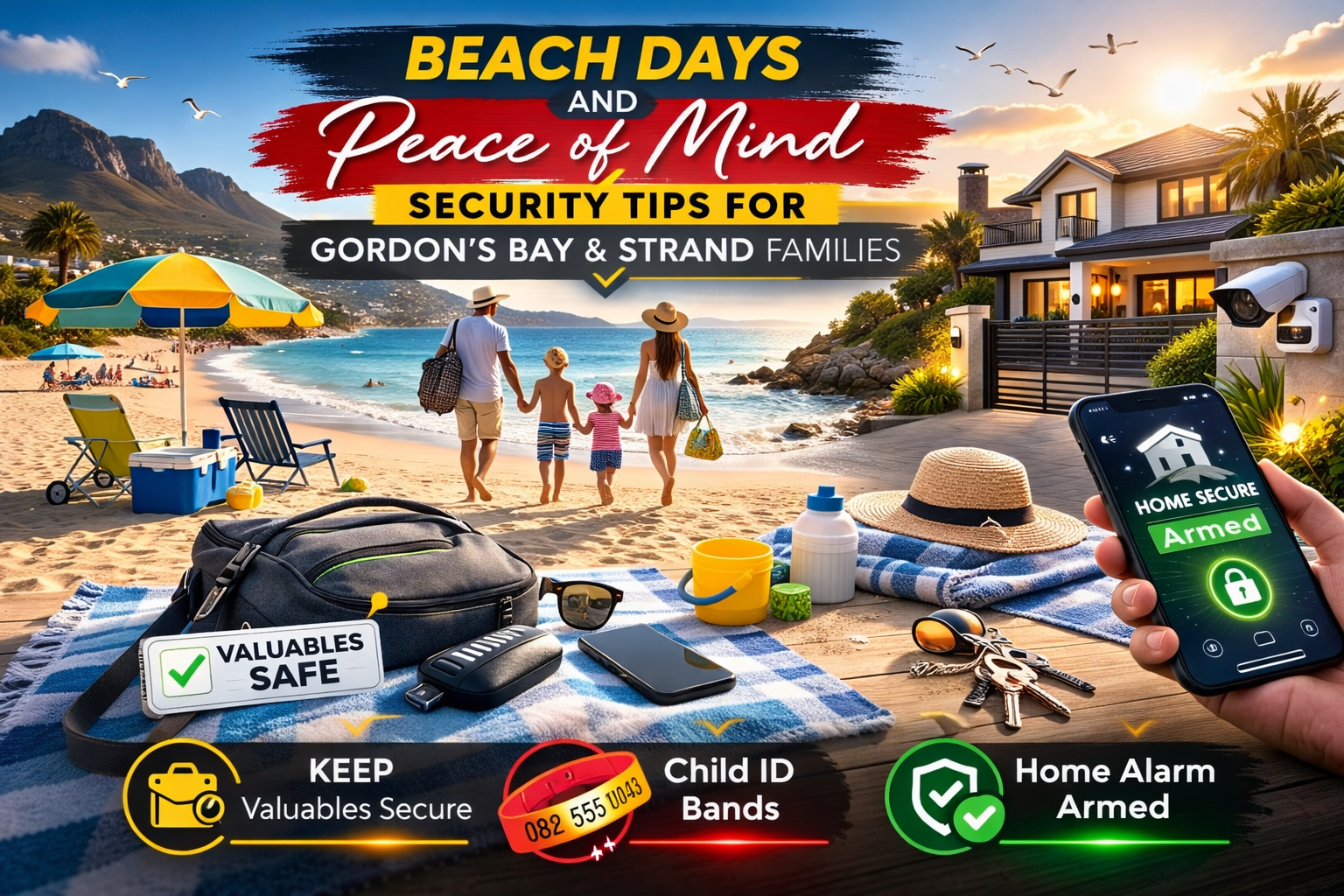
Beach Days and Peace of Mind: Security Tips for Gordon’s Bay and Strand Families
Beach days are part of Helderberg life. Gordon’s Bay and Strand families know the rhythm: a quick drive, a few hours on the sand, kids in and out of the water, and then home before the wind picks up.
The problem is not that the coastline is “unsafe”. The problem is that beach environments create predictable opportunities for small, fast opportunistic theft: a phone left under a towel, a car key hidden in the sand, a handbag placed in full view while everyone swims.
This guide is practical and local. It covers Strand beach safety and Gordon’s Bay holiday security with simple habits that keep valuables protected, children easier to reunite if separated, and your home properly armed while you enjoy the Helderberg coastline.
Beach Safety: The Real Risk Is Small, Fast Opportunism
Most beach-related incidents are not sophisticated. They are quick, low-risk and opportunistic.
Opportunistic theft usually looks like this:
- Someone watches where bags are placed.
- They wait for a moment when nobody is looking.
- They move fast, take one item, and disappear into normal foot traffic.
That means your best defence is not paranoia. It is routine: a few small choices that remove easy targets.
What to Take (And What to Leave at Home)
Beach days go better when you carry less. Minimal carry reduces stress and reduces loss if something goes missing.
Take Only What You Need
- One bank card (or a tap-to-pay option) and a small amount of cash.
- One phone per group, if possible, rather than multiple devices on the sand.
- One set of keys with a deliberate plan (see key section below).
- Basic ID if needed, but avoid carrying passports or additional documents.
Leave These at Home
- Spare car keys and spare house keys.
- Expensive jewellery and sentimental items.
- Large wallets with every card you own.
- Laptops, tablets and unnecessary electronics.
If you are going to the beach with family, you do not need your full daily carry. Strand beach safety starts with simplifying what you bring.
Anti-Theft Beach Setup: Simple Moves That Work
Most theft opportunities happen because valuables are visible, easy to access, and left unattended. A good setup reduces visibility and increases control.
Anti-Theft Beach Bags: What Matters
Anti-theft beach bags can help, but only if you choose features that solve beach-specific problems. The best features are practical, not gimmicky.
- Crossbody strap: keeps the bag attached to a person rather than a towel.
- Zipped compartments: prevents open-top “grab and go” theft.
- Internal pocket: keeps phone and card separate from sunscreen and snacks.
- Thicker strap material: reduces easy strap cutting in crowded spaces.
An “anti-theft” label means nothing if the bag still sits unattended in open view.
Where to Place Valuables on the Sand
Placement strategy matters more than any product.
- Do not place valuables on top of the towel in full view.
- Keep the bag close to the group, not on the edge of the walkway.
- Choose a position with natural visibility: near other families, not isolated.
- If possible, keep valuables physically attached to one adult in the group.
Take Turns Swimming
The simplest Strand beach safety rule is behavioural: not everyone swims at once.
- One adult stays with the setup while others swim.
- Rotate in short turns so nobody feels “stuck” watching bags all day.
It is not complicated. It is consistent.
Car Keys: The Most Common Beach Mistake
Car keys are often the single most risky item at the beach because people try to hide them.
The most common mistakes are:
- Hiding keys under a towel.
- Burying keys in the sand.
- Leaving keys in an unattended bag.
- Leaving a spare set in the car “just in case”.
Better Options
- Waterproof key pouch: a simple pouch worn under a rash vest or around the waist is one of the safest approaches.
- Dedicated key plan: one adult carries the keys, and everybody in the group knows who it is.
- Avoid “creative hiding”: hidden keys are still visible to anyone watching you hide them.
Gordon’s Bay holiday security is often compromised by one “quick” decision about keys. Make it deliberate instead.
Kids: Practical Safety That Doesn’t Kill the Vibe
Family beach days involve movement. Children run. Families separate briefly. Someone goes to the kiosk. In crowded summer conditions, the best approach is to make reunification easier if a child is separated.
Use a Simple Child ID Strategy
One practical approach is a child identification band or tag with a guardian phone number. Keep it simple and readable.
- Write a guardian contact number clearly.
- Use a band that stays on during swimming and play.
- Do not include unnecessary personal information.
Some beaches and communities run child identification initiatives from time to time. Use them where available, but do not rely on them as your only plan.
Set a Meeting Point Before Anyone Leaves the Blanket
Pick a meeting point and keep it consistent:
- A lifeguard station or a specific landmark.
- A specific colour umbrella or position relative to a fixed point.
- A rule for older kids: if lost, go to the meeting point and stay there.
Agree on the “What If We Get Separated?” Plan
- Children should know who to approach for help (lifeguards, beach staff).
- Children should know to stay in one place once they realise they are lost.
- Parents should avoid splitting in opposite directions without a plan.
The goal is calm reunification, not panic.
Before You Leave Home: 5-Minute “Away Mode” Checklist
Beach day security is not only about the beach. The other half is home. The difference between a relaxed afternoon and a stressed phone call is often whether the home base was correctly armed before you left.
Use this quick checklist before you drive out.
Alarm and Perimeter
- Arm the alarm properly: full arm rather than partial, unless pets or household routines require adjustments.
- Ensure outdoor beams are active if your system supports perimeter mode.
- Confirm electric fencing is on where applicable and stable.
CCTV and Notifications
- Confirm cameras are recording and storage is available.
- Check notifications are enabled for relevant zones.
Access Points
- Gate and garage: confirm fully closed and locked.
- Sliding doors and windows: ensure locks are engaged, not just “closed”.
Lighting and Presence
- Use timers where relevant for consistent evening patterns.
- Avoid leaving boxes or valuables visible through front windows.
Power and Communication Resilience
If you have experienced notification failures during load shedding, consider whether your router and fibre ONT have backup power. A working alarm panel is less useful if communication drops during an outage.
This checklist supports both Strand beach safety and Gordon’s Bay holiday security: the beach day is only peaceful if home remains stable.
If You’re Staying in a Holiday Rental
Holiday rentals often feel secure because they are “not your home”. That is a mistake. You still need to know what systems exist, what works, and what does not.
Check the Basics First
- Do sliding doors lock properly?
- Are window locks intact?
- Is exterior lighting functional?
- Are gates and pedestrian entrances secure?
Do Not Assume the Alarm Works
If the rental has an alarm panel, ask the host how it is armed and whether it is connected to response. If you cannot verify function, treat it as unverified and adjust your habits accordingly.
Control Your Access
- Keep keys together and controlled.
- Avoid leaving access remotes in visible areas.
- Confirm how visitors and deliveries are managed.
FAQ
What’s the safest way to handle car keys at the beach?
A waterproof key pouch worn on the body is one of the safest options. Avoid hiding keys under towels or burying them in sand, as that pattern is easy to observe.
Are anti-theft beach bags worth it?
They can help if they have practical features such as crossbody straps and zipped compartments. The bigger factor remains behaviour: keep valuables close, controlled and out of open view.
Should I leave my alarm armed with pets at home?
It depends on your system and sensor configuration. Many homes use perimeter modes that keep outdoor beams active while managing internal zones appropriately. If you are unsure, have your system assessed and configured correctly.
What should I do if my home alarm triggers while I’m at the beach?
Follow your established response plan. Verify the alert details, contact your armed response if applicable, and use CCTV verification where available. Avoid driving home aggressively without clarity; use structured escalation first.
How do I reduce risk without ruining the day?
Use simple routines: minimal carry, deliberate key handling, take turns swimming, and confirm your home is properly armed before you leave. Good security feels calm, not obsessive.
Conclusion: Keep the Day Light, Keep the Setup Tight
Beach days should be easy. The goal is not to “worry about safety” all day. The goal is to remove the easy opportunities that opportunistic theft depends on.
When your beach setup is controlled and your home is properly armed, you get what you came for: a relaxed afternoon on the Helderberg coastline and peace of mind on the drive home.
Book the Free Wind-Specific Perimeter Audit
If your home security is unreliable in summer conditions, it is worth checking whether wind exposure, mounting drift or coastal corrosion is undermining performance. Our Free Wind-Specific Perimeter Audit focuses on measurable reliability, not generic advice.
We assess:
- Beam placement and sensitivity
- Electric fence tension and stability
- Mounting integrity
- Coastal corrosion impact
- Seasonal wind exposure mapping
Enjoy the beach. We will make sure your perimeter holds while you are away.