Gated Estate vs. Freestanding Home: Customising Your Somerset West Security
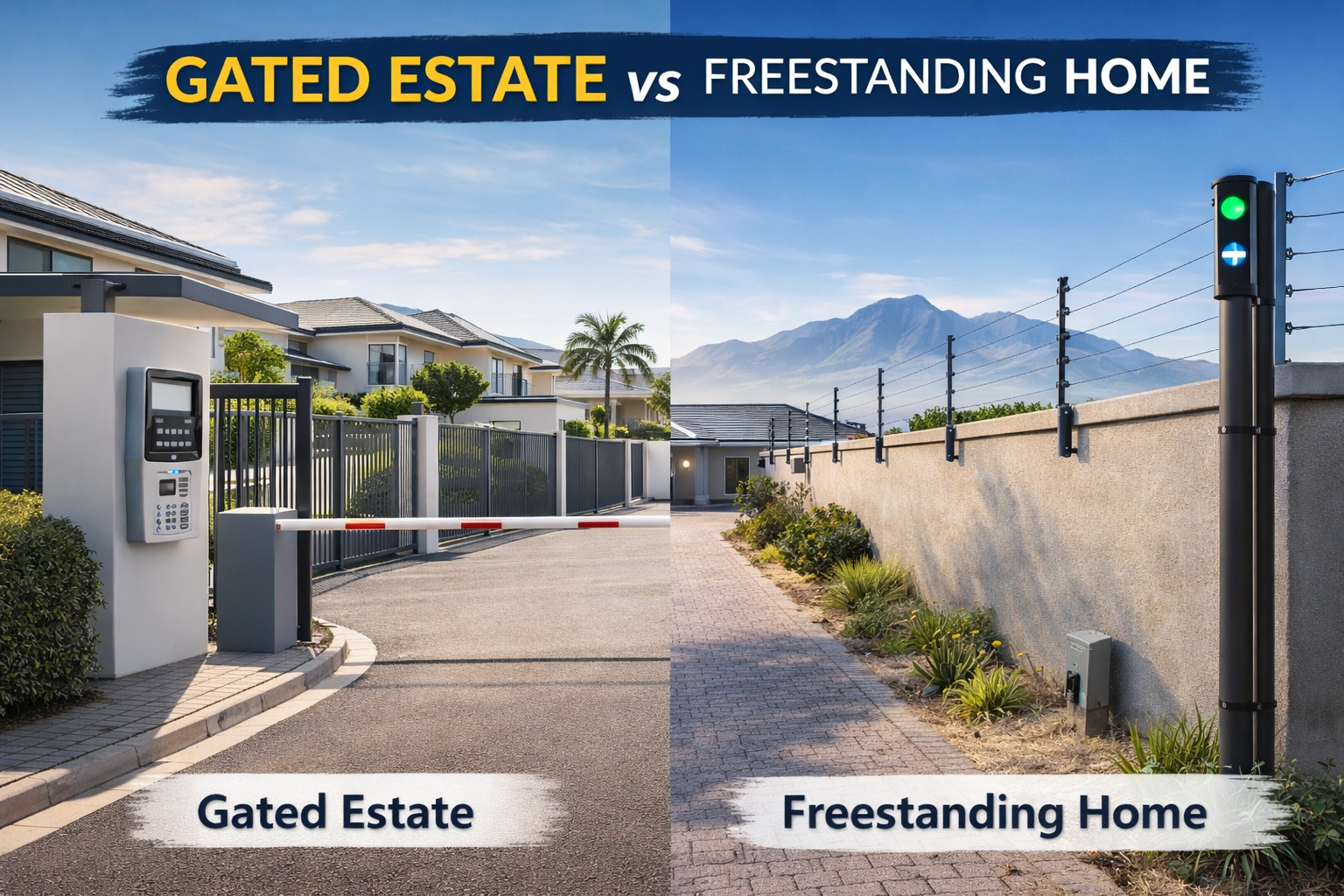
Somerset West has a mix of property types: gated estates with access control and patrols, and freestanding homes with full boundary responsibility on the owner. The mistake most people make is assuming the risk model is the same for both.
It isn’t.
Estate living can create a false sense of security: “The gate is controlled, so we’re fine.” Freestanding homes can create the opposite: “We need everything, everywhere, all at once.” Both approaches lead to gaps, false alarms, wasted spend, and systems that are installed but not engineered.
Helderberg Security Services designs security based on how the property actually works: the approach routes, the rules, the environment, and what happens during wind and power interruptions. This guide breaks down the practical differences between Somerset West gated estates and freestanding home security so you can choose the right layers — not generic packages.
What Estates Usually Do Well (And Where the Gaps Are)
Most Somerset West gated estates invest heavily in the estate-level perimeter and access management. Done properly, that’s a strong first layer.
What Estates Typically Get Right
- Access control: controlled vehicle and pedestrian entry, visitor logging, intercom processes.
- Perimeter fencing: estate-managed boundary fencing and maintenance schedules.
- Patrol presence: visible patrols and response procedures inside the estate.
- Rules and standards: consistent guidelines that reduce random DIY “security experiments”.
These layers reduce casual walk-in risk and can improve response coordination.
Where Estate Homes Often Become Vulnerable
The gap is usually inside the perimeter. Estates protect the community boundary, but they do not automatically harden the individual unit.
- Complacency: doors left unlocked, garage doors left partially open, windows left open because “we’re in an estate”.
- Internal blind spots: balcony doors, side passages, and garages treated as “safe zones”.
- Weak verification: alarms that trigger but no camera verification or structured response sequence.
- Rules-driven compromises: camera placement restrictions or limitations on external detection devices.
A secure estate does not replace a secure home. It changes which layers matter most.
Freestanding Homes: Why the Perimeter Must Work Harder
Freestanding home security is a different game because the boundary is yours. More boundary equals more approach routes, more concealment opportunities, and more points of failure if the perimeter is not engineered.
Typical characteristics of freestanding home security:
- Longer fence lines and more corners.
- Multiple access points: driveway, pedestrian gate, side passages, garden access, rear boundaries.
- Greater reliance on perimeter detection and deterrence.
- Higher exposure to environmental factors (wind corridors, slope vibration, coastal corrosion depending on location).
This is where perimeter security Somerset West requires a structured approach: stable mounting, correct placement, proper calibration, and comms resilience.
Perimeter-First, Not Panic-First
Freestanding homes do not need “everything”. They need the right perimeter layers in the right places:
- Outdoor detection: correctly calibrated beams in true approach corridors.
- Fence integrity: electric fence Somerset West stability where applicable, including tension and voltage consistency.
- Access control: a gate motor and pedestrian gate setup that does not rely on hope.
- Camera coverage planning: cameras placed to observe approach routes and decision points, not just walls.
When the perimeter is predictable, the inside becomes simpler.
Security Rules and Constraints: Estates vs. Private Properties
Estate security rules exist for a reason: aesthetics, uniform standards, safety and liability. But rules can also create blind spots if the system is not designed around them.
Estates: Rules You Must Design Around
- Restrictions on drilling, pole mounting, and device visibility.
- Limitations on external beams or their placement.
- Rules around camera placement, height, angles, and privacy boundaries.
- Guidelines for gate motors, intercoms and cabling routes.
- Constraints on electric fencing modifications or energiser choices.
In estates, “freestanding thinking” often fails because you can’t just place devices wherever you like. The design must be compliant and still effective.
Freestanding Homes: Fewer Rules, More Responsibility
Freestanding homes have far fewer constraints, but that does not mean everything should go everywhere.
- You can install more perimeter devices, but placement still matters.
- You can add more cameras, but without planning you get blind spots and unusable footage.
- You can add more power backup, but without prioritising the right devices you still lose comms.
Engineering is choosing what matters most and making it stable.
System Design Differences (Practical Examples)
The biggest difference between estate security rules and freestanding home security is the design emphasis. Estates tend to need stronger internal layering. Freestanding homes tend to need stronger perimeter engineering.
Estate Homes: Layered Internal Protection
In estates, the “outside” layer is partly managed. Your unit needs a reliable internal model that focuses on doors, garages, balcony access and verification.
- Alarm zoning and partitions: separate zones for bedrooms, living areas, garage and perimeter points.
- Door/window contacts: strong emphasis on entry points rather than relying only on motion detection.
- Garage protection: garage doors and internal access doors treated as primary entry points.
- CCTV verification: cameras positioned to confirm an event quickly without guesswork.
Estate living often benefits from a clean “night mode” design that keeps you secure without turning the home into a false-alarm trap.
Freestanding Homes: Perimeter Detection and Stability
Freestanding homes need a perimeter that detects early and holds steady under environmental pressure.
- Outdoor beams calibration: reduce false triggers while maintaining detection where approach routes matter.
- Mounting integrity: stable posts and brackets that do not drift in wind or loosen over time.
- Fence optimisation: tension, voltage stability, earthing and fault patterns reviewed, not assumed.
- Access control reinforcement: pedestrian gate and gate motor security treated as a system, not a single device.
Perimeter systems that are stable reduce the need for aggressive internal sensitivity that creates nuisance triggers.
Scenario Examples
Scenario 1: Windy Day (Cape Doctor Conditions)
- Estate: internal zones should remain stable; external rules may limit beams, so you rely on solid door contacts and camera verification.
- Freestanding: perimeter beams and fence stability are tested against wind-driven vibration and vegetation oscillation; calibration prevents false alarms.
Scenario 2: Load Shedding or Unexpected Power Drop
- Estate: if your home system loses router/ONT power, you may still be armed but lose notifications. Backup needs to prioritise comms and the alarm panel.
- Freestanding: same risk, plus gate motor behaviour and perimeter detection continuity. A comms plan matters as much as a battery.
Scenario 3: Quick Trip Out (School Run, Shops, Beach)
- Estate: ensure “away mode” arms the correct entry points (garage, doors, balcony) without leaving zones unarmed because it feels “safe”.
- Freestanding: “away mode” must include perimeter detection and verify camera recording, because the boundary is larger and access is easier.
The “Away Mode” and “Night Mode” Setup
A strong system is not only hardware. It is daily usability. Most failures happen because the system is annoying to use, so people bypass it.
Estate “Night Mode” (Typical)
- Arm entry points: doors, balcony doors, garage-to-house door.
- Use partitions: keep bedroom zones free to move, arm living areas if required.
- Enable camera verification: key angles that show driveway, front door, or side access points.
Freestanding “Night Mode” (Typical)
- Perimeter first: beams and fence stable and active.
- Internal zones strategic: avoid over-sensitivity that triggers on pets or airflow.
- Lighting coordination: security lighting aligned to approach routes and camera views.
False Alarm Reduction Without Weakening Security
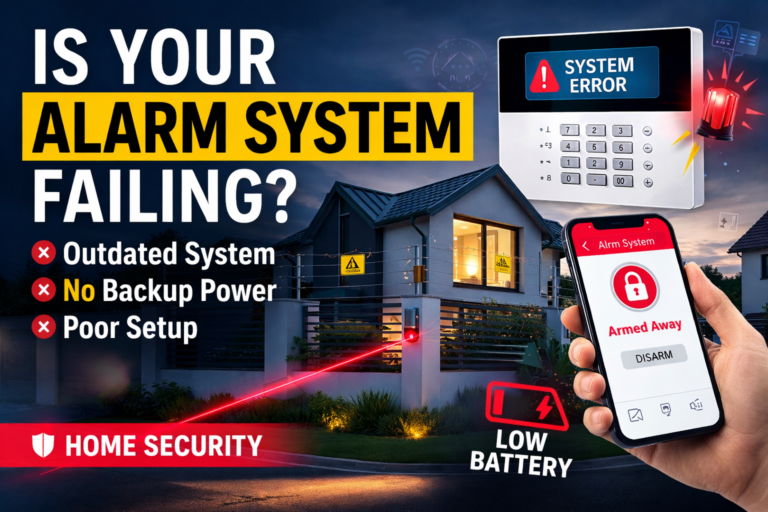
False alarms usually come from:
- Over-sensitive settings in wind-affected zones.
- Vegetation too close to detection paths.
- Mounting drift and misalignment.
- Poorly designed zones that trigger from normal living movement.
Correct design filters environmental noise and keeps detection focused where it matters.
Checklist: What to Audit When You Move In
If you are semigrating into Somerset West or moving between property types, do not assume inherited systems are correctly configured.
- Change codes: alarm codes, gate codes, intercom PINs, and app logins.
- Control remotes: gate and garage remotes accounted for and reset where possible.
- Alarm history: confirm what triggers what, and whether zones are labelled correctly.
- CCTV admin access: ensure you control the recorder/app credentials, not the previous owner.
- Camera positioning: confirm approach routes are covered, not only static walls.
- Entry points: test doors, sliding doors, windows and garage access points.
- Perimeter devices: check outdoor beams alignment and placement where applicable.
- Fence condition: tension, insulators, earthing and voltage stability for electric fencing.
- Backup power and comms: confirm alarm panel battery health and whether router/ONT has backup.
This move-in audit prevents months of “we thought it was working” and protects you from inherited misconfiguration.
FAQ
Do I still need an alarm in an estate?
Yes. Estate layers reduce certain risks, but they do not secure your unit’s doors, garage access, balcony routes or internal vulnerabilities. Your home still needs a properly designed system.
What’s the most common mistake new estate buyers make?
Complacency: leaving doors and garages unsecured because the estate has access control. The estate perimeter is one layer, not the whole system.
Can you install beams in estates with strict rules?
Often yes, but the design must align with estate security rules and privacy constraints. Where external beams are limited, we strengthen internal layers and verification instead of forcing non-compliant installs.
How do I reduce false alarms without weakening security?
Focus on correct placement, stable mounting, appropriate sensitivity settings, and clear zoning. False alarms are usually design and calibration issues, not a reason to turn security “down”.
What power backup is “enough” for security?
Backup should prioritise the alarm panel, communications (router/ONT where needed) and any critical detection devices. A battery that keeps the panel on but kills notifications is not sufficient for many households.
Do you service Gordon’s Bay and Strand too?
Yes. We cover Somerset West, Gordon’s Bay and Strand, with a focus on perimeter reliability in wind-affected and coastal conditions.
Conclusion: Security That Matches the Property Type
Estate security and freestanding home security require different design priorities. Estates benefit from strong internal layering and verification that complements estate-level control. Freestanding homes require perimeter engineering, stability and calibration that holds across longer boundaries and environmental pressure.
The answer is not “more equipment”. The answer is the right design for the real-world conditions of your property.
Book the Free Wind-Specific Perimeter Audit
Whether you live in a Somerset West gated estate or a freestanding home, reliability matters. If your system triggers randomly, drifts in wind, or has unknown calibration history, an audit identifies the measurable weaknesses.
Our Free Wind-Specific Perimeter Audit includes:
- Beam placement and sensitivity review
- Mounting integrity inspection
- Electric fence stability and fault pattern checks (where applicable)
- Coastal corrosion assessment
- Wind exposure mapping and risk points
Stop guessing. Engineer the system for how Somerset West actually behaves.
Meta Title
Somerset West Gated Estate vs Freestanding Security
Meta Description
Estate vs freestanding home security in Somerset West: rules, risks and the right system design. Reduce false alarms and build reliable layers.